
The Thermodynamic Capital Stack
When Energy Powers the Economy and Capital Moves at Machine Speed

ISSUE #11 March 18, 2026
In Issue #06, we stabilized inputs (Data).
In Issue #07, we granted bounded authority (Agency).
In Issue #08, we connected those agents into a continuous clearing network (The Silent Market).
In Issue #09, we dissolved the corporation into temporary coordination organisms (The Ephemeral Firm).
In Issue #10, we made the physical world addressable, turning atoms into APIs so software could command factories, vehicles, and supply chains.
At this point, the architecture of the machine economy is nearly complete.
Machines can detect opportunities, coordinate labor, command infrastructure, and execute in the physical world.
But even a perfect engine cannot run without fuel.
Which leads to the next unavoidable question:
What powers a machine-speed economy?
Software may orchestrate reality, but every manipulation of atoms requires energy, and every calculation requires compute.
A simple robotic welding operation can consume 3 - 10 kWh of electricity per hour.
Training a frontier AI model may require 5 - 10 GWh of energy, roughly the annual electricity usage of 1,000 European homes.
A hyperscale AI data center today can draw 100 - 300 megawatts of continuous power, approximately equal to the energy demand of a small city.
The machine economy therefore runs on a deeper substrate than money or software. It runs on thermodynamics. We are entering into the era of the Thermodynamic Capital Stack.
The Thermodynamic Capital Stack describes an economy where energy becomes the base resource, compute becomes its transport layer, and autonomous capital becomes the routing protocol directing both toward profitable work.
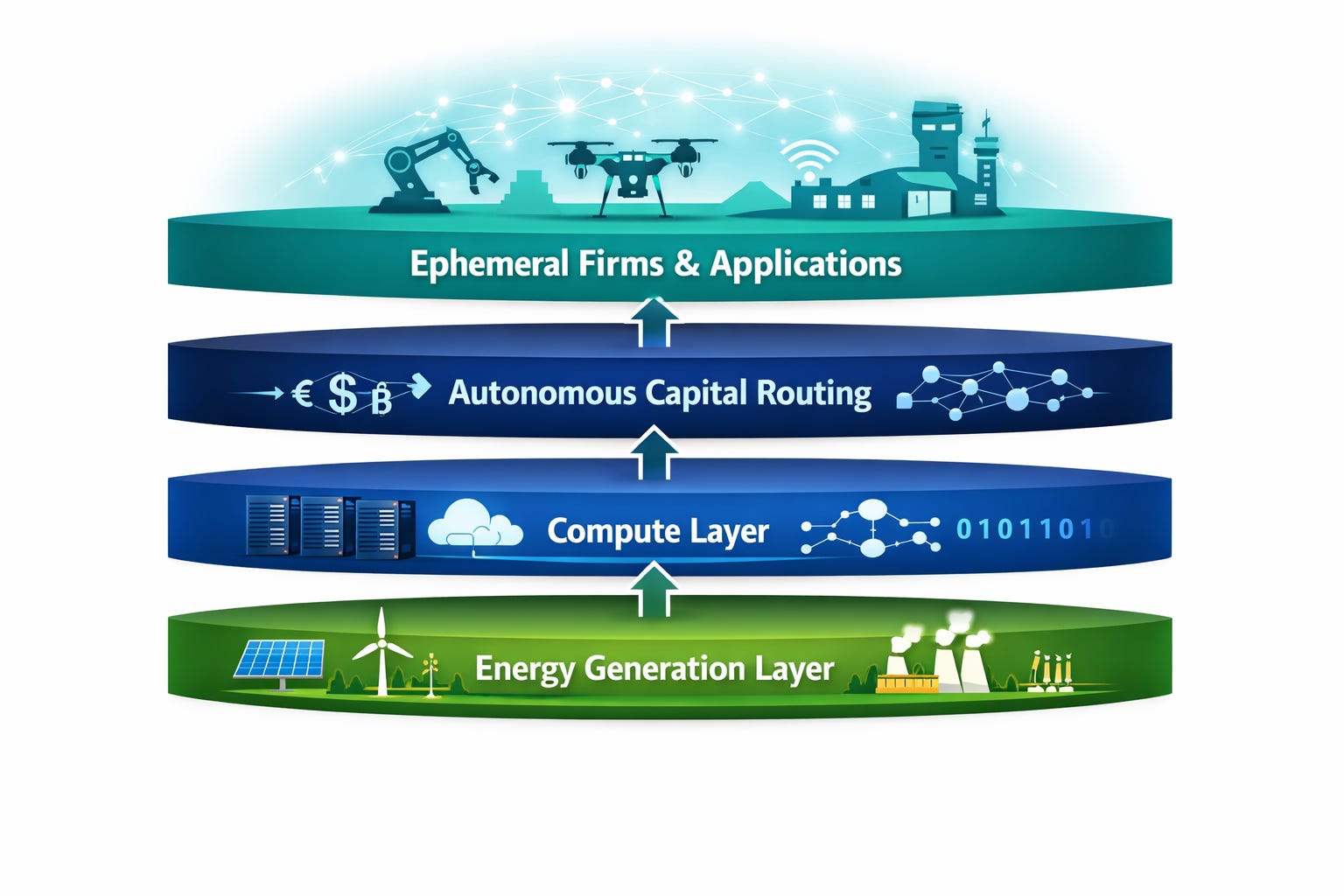
Figure 1: The Thermodynamic Capital Stack. A layered architecture of the machine economy showing how physical energy is transformed into global economic activity. Energy generation and physical infrastructure form the base layer, computation converts energy into portable intelligence, autonomous capital routes resources to opportunities, markets coordinate transactions, and Ephemeral Firms execute economic tasks.
The Energy Bottleneck
When factories, logistics fleets, robotic arms, and supply chains become programmable, their utilization rates explode.
Autonomous infrastructure does not sleep. It does not wait for shifts to change or offices to open.
An AI-directed factory can operate continuously, adjusting production minute by minute to match global demand signals. This creates unprecedented volatility in energy demand. Trying to fuel such an economy with static electricity contracts and monthly billing cycles is like trying to power a supersonic jet with a horse’s feed trough.
The infrastructure simply cannot keep up.
Historically, energy markets evolved around predictable human activity; commuting cycles, office hours, seasonal heating.
But machine economies do not follow human rhythms. They follow algorithmic opportunity.
Global electricity consumption already exceeds 29,000 terawatt-hours (TWh) per year, and AI data centers alone are projected to consume around 1,000 TWh annually by the early 2030s roughly equivalent to the entire electricity demand of Japan today.
Routing power through legacy financial and utility systems in such an environment is the exact equivalent to using a sundial to calibrate a quantum computer. The instruments were built for another era.
Energy Becomes the Native Currency
In the industrial era, money priced labor.
In the digital era, money priced information.
In the machine economy, the ultimate scarce resource becomes energy conversion.
Every robotic movement, every logistics route, and every AI inference requires a precise quantity of power.
When machines negotiate economic activity, they are not fundamentally reasoning in dollars.
They are reasoning in joules, watts, and floating-point operations per second (FLOPS).
The Thermodynamic Capital Stack therefore merges energy, compute, and capital into a unified economic layer.
An Ephemeral Firm may hold reserves of:
• compute credits measured in petaflop-hours
• energy derivatives priced in €/MWh
• autonomous liquidity pools allocated algorithmically
If electricity costs €60/MWh, a process consuming 2 kWh carries a direct thermodynamic cost of €0.12 before logistics or capital costs are added.
Capital and power move together. Traditional money behaves like water sitting quietly in a reservoir. Thermodynamic capital behaves like an intelligent irrigation system automatically routing energy toward the most productive crops. Liquidity becomes kinetic.
Compute: The Liquid State of Energy
Electricity cannot travel across the world efficiently.
Long-distance high-voltage transmission typically loses 5 - 10% of energy.
Computation, however, can move globally with negligible loss through fiber networks.
This leads to one of the most profound shifts of the machine era:
Compute becomes the liquid state of energy.
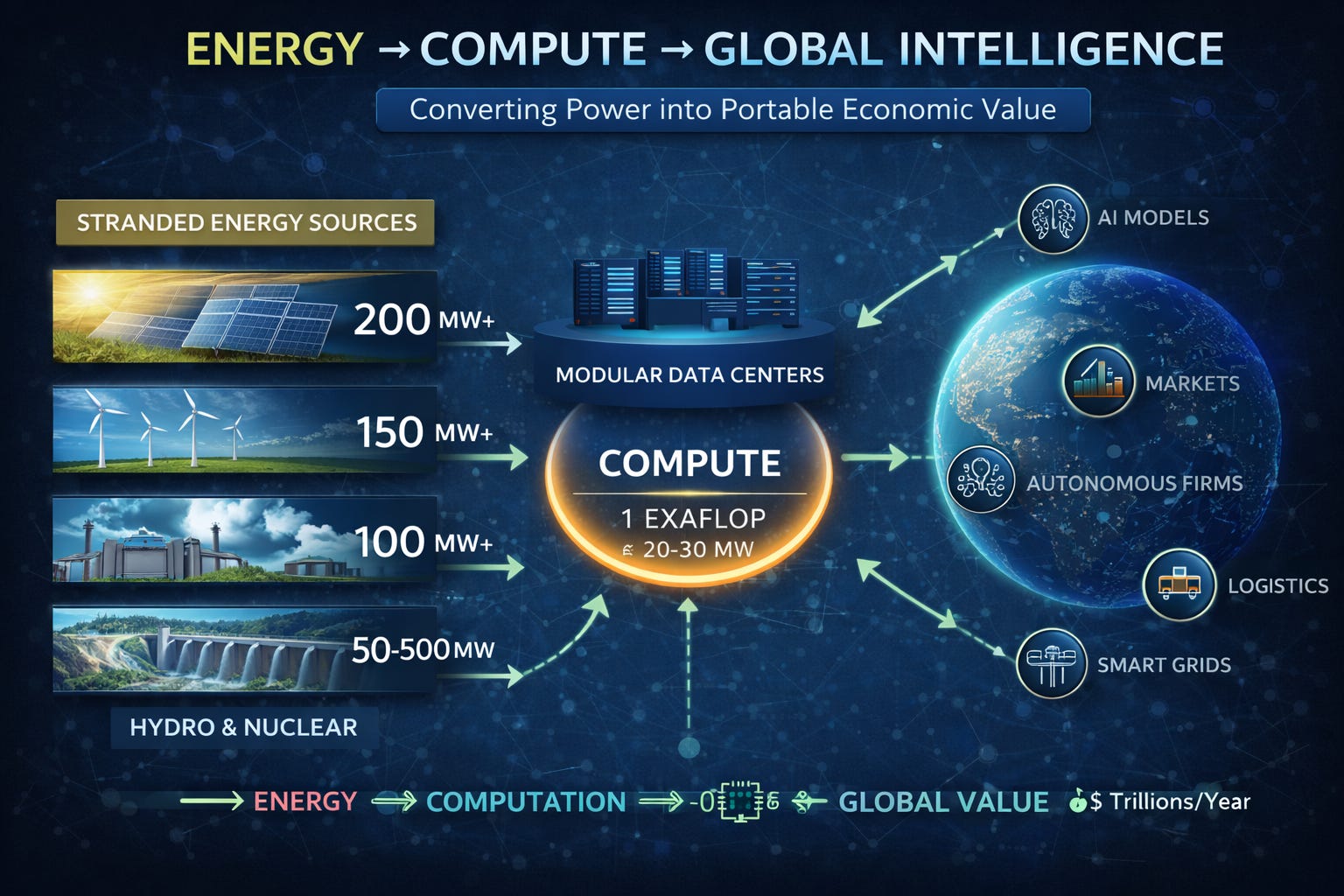
Figure 2: Energy-to-Compute Conversion. Stranded energy sources such as solar, wind, geothermal, and hydro are converted into portable economic output through modular data centers. Energy becomes computation, which can then be transmitted globally with near-zero loss.
Instead of transporting electricity across continents, the machine economy transports computation.
When solar farms in North Africa generate excess power at noon, autonomous systems can route AI workloads to nearby modular data centers.
The electricity is instantly converted into computation and transmitted globally.
A modern AI compute cluster delivering 1 exaflop of processing power may require 20 - 30 megawatts of electricity, turning raw energy directly into intelligence.
Stranded power is like a remote oil well in the desert; pair it with mobile compute, and it becomes a globally tradable commodity.
The machine economy does not move power to the city. It moves the city’s computation to the power.
Stranded Power as Sovereign Wealth
Historically, energy infrastructure had to be built near population centers.
Transmission constraints left vast amounts of energy potential economically useless, in the light of: remote geothermal reservoirs, isolated wind corridors, overproducing solar regions.
But when compute becomes portable and autonomous, these energy sources transform into sovereign thermodynamic reserves.
Modular compute nodes can deploy directly next to energy generation sites, converting megawatts into globally tradable computation.
A 200-MW solar farm paired with modular compute infrastructure could produce over 1.5 TWh of computational energy annually.
The geopolitical implications are enormous.
In the industrial age, oil wells determined global influence. In the machine age, data centers attached to energy sources function like digital refineries. Energy is thus refined into intelligence.
The Rise of Autonomous Capital
As energy and compute become tradable primitives, capital itself must evolve.
Human capital allocation cycles:- investment committees, loan approvals, quarterly budgets are far too slow for a machine economy where opportunities appear and disappear in seconds.
Autonomous liquidity pools already exceed $80 billion in decentralized finance markets, demonstrating how capital can move automatically according to algorithmic rules.
In a thermodynamic economy, such liquidity pools allocate funding directly to Ephemeral Firms executing real-world tasks, i.e manufacturing capacity, energy arbitrage, logistics optimization; all financed instantly.
Running such a machine economy on human capital approval cycles is the same as forcing a fiber-optic data stream through a copper telephone wire.
The power exists, but the conduit cannot keep up.
Programmable capital becomes the bloodstream of autonomous infrastructure.
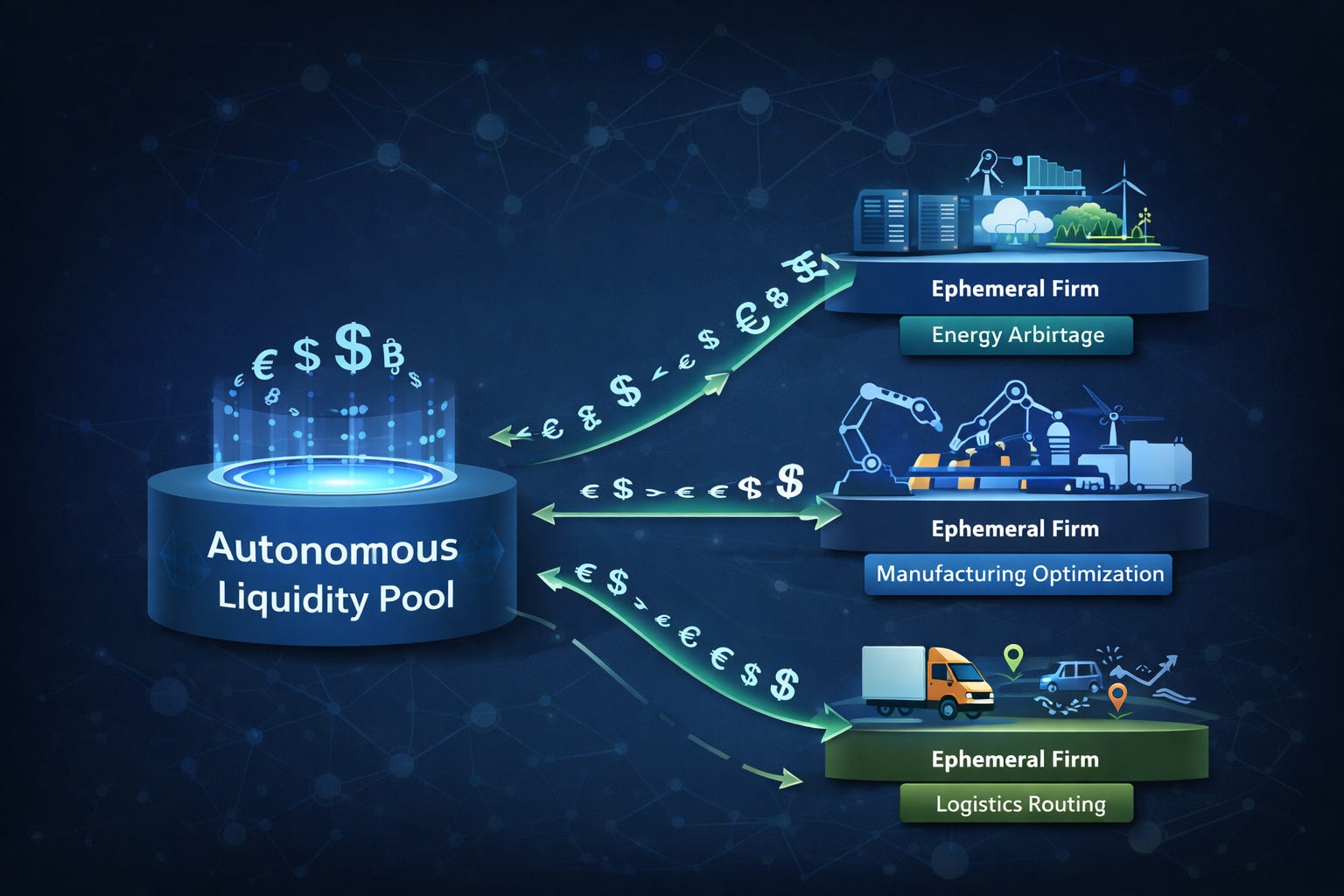
Figure 3: Autonomous Capital Allocation. Diagram illustrating how programmable liquidity pools automatically allocate capital to Ephemeral Firms performing tasks across manufacturing, energy arbitrage, and logistics networks.
The Risk of Gridlock
Connecting autonomous capital directly to global energy systems introduces the possibility of algorithmic feedback loops.
Imagine millions of autonomous agents simultaneously bidding for electricity during a winter storm.
Power prices spike.
Algorithms rush to secure supply.
Grid demand surges beyond physical limits.
Electricity markets already experience price swings exceeding 500% during extreme demand events.
At machine speed, such volatility could trigger cascading blackouts before human regulators even understand the anomaly.
This would be the economic equivalent of thousands of automated trading bots stampeding through a narrow doorway at the same time.
To prevent this, the machine economy requires Thermodynamic Circuit Breakers, which are hard-coded limits that regulate how quickly autonomous systems can draw energy.
A high-performance engine without dampening systems eventually tears itself apart.
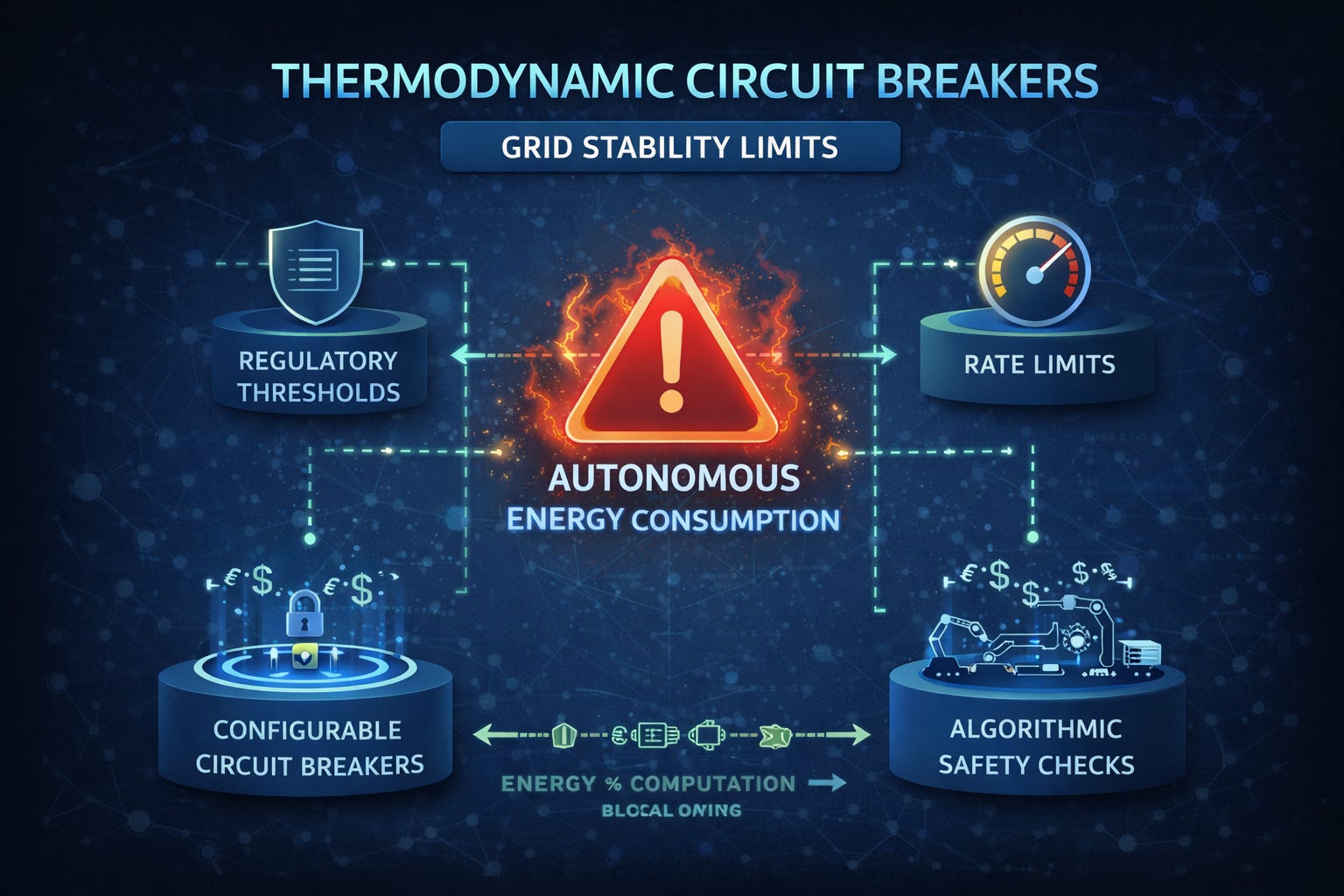
Figure 4: Thermodynamic Circuit Breakers. Conceptual model of safeguards that limit the rate at which autonomous systems can consume energy, preventing algorithmic feedback loops from destabilizing physical infrastructure such as power grids.
The Planetary Power Router
As these systems mature, electricity networks, compute infrastructure, and autonomous capital pools integrate into a single adaptive system.
Power flows to wherever it is most valuable.
Compute flows to wherever energy is cheapest.
Capital flows to wherever both converge.
The emerging machine economy begins to resemble a planetary metabolism whereby energy enters the system, computation processes it, and capital circulates it toward useful work.
What the internet did for information, the Thermodynamic Capital Stack will do for power and capital.
A planetary nervous system routing energy and intelligence across the global economy.
The Provocation
For most of modern history, economic dominance depended on control of labor, land, or financial capital.
The machine economy introduces a deeper constraint: Energy.
Software is rapidly becoming commoditized by AI.
Capital is becoming programmable.
Coordination is becoming automated.
The ultimate bottleneck becomes the ability to convert energy into computation and physical work.
Global energy investment already exceeds $3 trillion per year, and AI infrastructure alone is expected to require hundreds of billions of dollars annually in new power capacity.
Investing in autonomous systems without securing thermodynamic infrastructure is like buying prime real estate on the moon without owning a rocket.
The underlying physics determines everything.
The Investor’s Bottom Line
As the Thermodynamic Capital Stack emerges, three layers will capture extraordinary venture returns.
Algorithmic Energy Markets
Software allowing distributed assets; EV fleets, batteries, buildings, factories to autonomously buy and sell electricity in real time.
Even modest EV participation could unlock hundreds of gigawatt-hours of flexible grid storage capacity. Every device connected to the grid becomes a miniature power trader.
Modular Compute Infrastructure
Deployable data centers capable of installing directly at stranded energy sites.
A 50-MW modular compute cluster can generate trillions of AI inferences per day, transforming remote megawatts into liquid digital productivity.
Autonomous Capital Protocols
Liquidity networks capable of allocating funding instantly to machine-driven economic opportunities.
These protocols function as the financial nervous system of the machine economy, ensuring capital flows precisely where thermodynamic resources generate the highest return.
Closing Thought
First, we digitized information.
Then, we digitized coordination.
Now, we are digitizing physics itself.
Energy, compute, capital, and infrastructure are merging into a single planetary operating system.
If the Industrial Revolution built machines to amplify human labour, the machine economy is building machines that amplify energy itself.
And in that world, wealth will no longer be measured only in money,
BUT in how efficiently a system converts energy into intelligence and action.
Dr Saanfor Hubert
If you find these analyses useful, consider subscribing to the weekly ACG Newsletter.
Each issue explores the intersection of technology, markets, and institutional change, focusing on how AI, autonomous systems, and new economic architectures are reshaping the global economy.