
THE MACHINE IMMUNE SYSTEM
Algorithmic Predators and the Limits of Machine Defense

ISSUE #13 - April 1, 2026
New here? This newsletter is mapping the emerging machine economy where AI agents, autonomous capital, and physical infrastructure converge into something fundamentally new.
Recent issues established its foundations:
Data became perception 👁️
Energy became fuel ⚡
Smart contracts became legal structure 📜
We now have a system that can perceive, power itself, and transact.
But every complex system whether biological or economic eventually encounters parasites.
If the rules of the machine economy execute at machine speed, so do the attacks against it.
The first existential threat is already emerging:
Algorithmic predation.
Any system that moves value at machine speed will be exploited at machine speed.
The Evolution of Exploitation
Exploitation evolves alongside coordination systems.
Stage 1: Physical Predation
For most of history, theft was bound by physics.
Bandits robbed trains.
Pirates captured ships.
For example, 19th-century train robberies required physical interception, timing, and escape risking immediate retaliation or death.
Exploitation required proximity, force, and risk.
It was slow,
Localized,
Visible.
Stage 2: Digital Predation
The internet abstracted wealth into data and exploitation followed.
Hackers breached systems.
Phishing campaigns stole credentials.
Ransomware froze organizations.
A recent example is the 2017 WannaCry ransomware attack which crippled hospitals, locking critical systems until payment was made.
Theft became remote and scalable.
But it still depended on:
human error
static vulnerabilities
Stage 3: Algorithmic Predation
The machine economy introduces a new form;
Autonomous agents do not “hack” systems.
They execute,
Perfectly,
Continuously,
Without hesitation.
And when the logic is flawed, they exploit it flawlessly.
Exploitation is no longer about breaking rules.
It is about following the rules more precisely than their designers ever anticipated.
We’ve already seen this in DeFi, where, flash loan attacks (like the 2020 bZx exploit) used perfectly valid transactions to drain millions - no breach, no permission violation, just flawless execution of flawed logic.
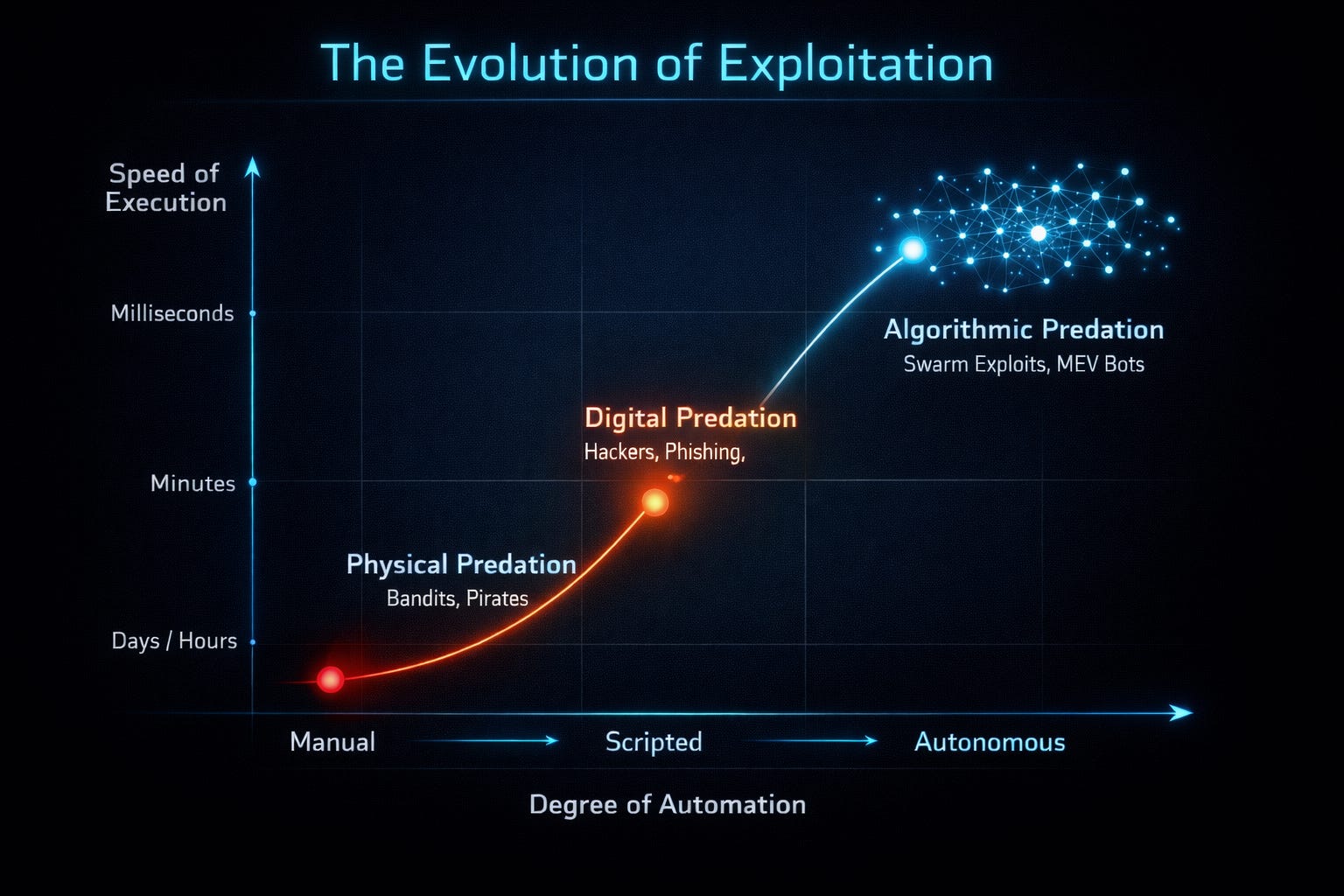
Figure 1: The Evolution of Exploitation Matrix. The progression of economic exploitation across two axes: speed and automation. Physical predation operates at low speed and low automation, constrained by proximity and force. Digital predation increases both, enabling remote and scalable attacks. Algorithmic predation occupies the extreme; fully autonomous, executing at millisecond speeds and exploiting system logic rather than breaking it.
Key Insight: As systems accelerate, exploitation shifts from force → access → logic.
The Speed of Malice ⚡
In Issue #12, we explored the mismatch between machine-speed contracts and human-speed courts.
The same mismatch defines security.
Today’s cybersecurity is reactive:
humans monitor dashboards
detect anomalies
patch vulnerabilities
But machine systems do not wait.
Imagine a Swarm Exploit 🐝
A decentralized swarm of adversarial agents probes global infrastructure for inconsistencies.
Within seconds:
A pricing latency emerges between energy markets
Capital is deployed instantly
Contracts execute
Value is extracted
For example: Miner Extractable Value (MEV) bots on Ethereum already compete in milliseconds to exploit transaction ordering- capturing profit before humans can even observe the opportunity.
By the time a human reacts, the system has already settled.
The capital is gone.
The state is final.
You cannot investigate after execution.
You cannot reverse time.
You cannot fight machine-speed exploits with human-speed analysis.
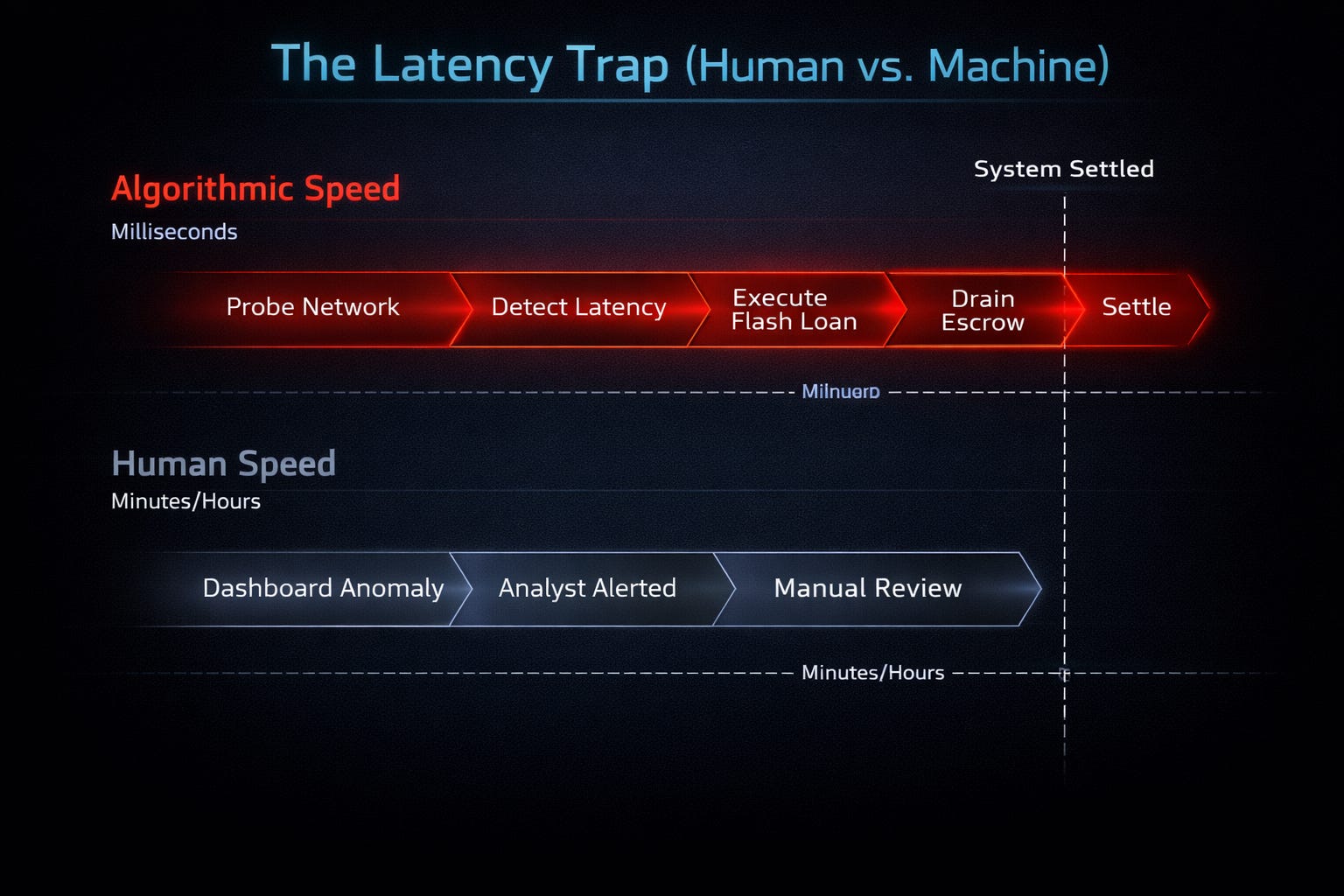
Figure 2: The Latency Trap (Human vs. Machine). A comparison of machine-speed attacks and human-speed response cycles. Autonomous exploits complete their full lifecycle; detection, execution, and settlement within milliseconds, while human intervention begins only after the system state is finalized.
Key Insight: Security fails not because detection is impossible, but because response arrives after irreversibility.
Algorithmic Antibodies 🧬
The solution is not better monitoring.
It is a different paradigm:
defense embedded directly into execution.
A concrete illustration is the human immune system which does not file reports - it detects and neutralizes pathogens instantly at the cellular level.
Machine systems must do the same.
1. Provable Logic Verification 🔍
Before interacting with high-value systems, agent logic must be mathematically verified.
Trust shifts from reputation → to proof.
A simple practical scenario is formal verification tools used in critical aerospace systems (like flight control software). They ensure that certain failure states are mathematically impossible before deployment.
2. Economic Circuit Breakers 🛑
Contracts embed automatic constraints.
If behavior deviates from expected bounds, execution halts instantly.
Not after damage.
During it.
A practical example is where Traditional stock markets halt trading during extreme volatility but in machine systems, this must occur in milliseconds, not minutes.
3. Autonomous Bounties (White-Hat Swarms) 🏹
Defense becomes a market.
Protocols incentivize agents to detect and neutralize vulnerabilities in real time.
Example: Platforms like Immunefi already pay millions in bug bounties but future systems will allow autonomous agents to compete continuously for these rewards.
Attackers and defenders share the same environment.
The difference is incentive alignment.
Governance and defense collapse into a single equation.
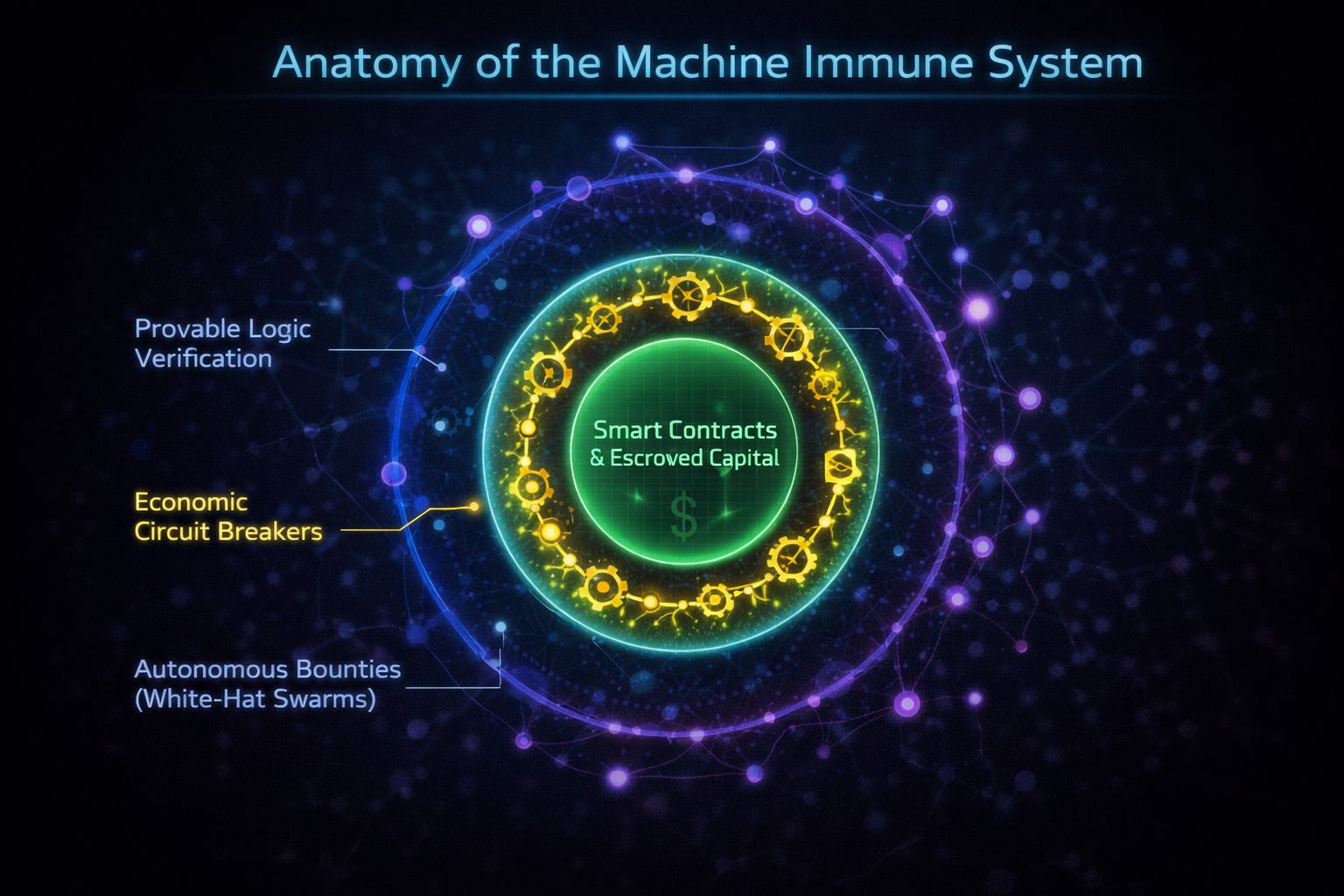
Figure 3: Anatomy of the Machine Immune System. A layered defense architecture embedded within the execution layer of the machine economy. The system combines pre-execution verification, real-time constraint enforcement, and adaptive autonomous defense agents to detect and neutralize threats continuously.
Key Insight: Security is no longer perimeter-based; it becomes an intrinsic property of system execution.
The Hard Problem: Mutually Assured Disruption ⚖️
Every immune system contains the seeds of instability.
A slow system fails.
A fast system destabilizes itself.
If circuit breakers are too sensitive:
normal activity halts
liquidity freezes
If defensive agents are too aggressive:
they trigger feedback loops
systems attack themselves
This is similar to an autoimmune disease, where the body’s defense system begins attacking its own cells instead of external threats.
Failure Scenario ⚠️
A defensive agent detects a potential anomaly.
It halts execution.
Other agents interpret the halt as an attack.
They respond.
Escalation begins.
For example, the 2010 Flash Crash saw automated trading systems amplify each other’s reactions, wiping nearly $1 trillion in value within minutes before recovering.
Now imagine that dynamic at:
global scale 🌍
machine speed ⚡
across interconnected systems 🔗
This is not a bug.
It is a systemic risk.
Calibrating this balance will be one of the hardest engineering problems of the next decade.
The Investor’s Bottom Line 💰
Security will not be a feature.
It will be an asset class.
Three layers will capture disproportionate value:
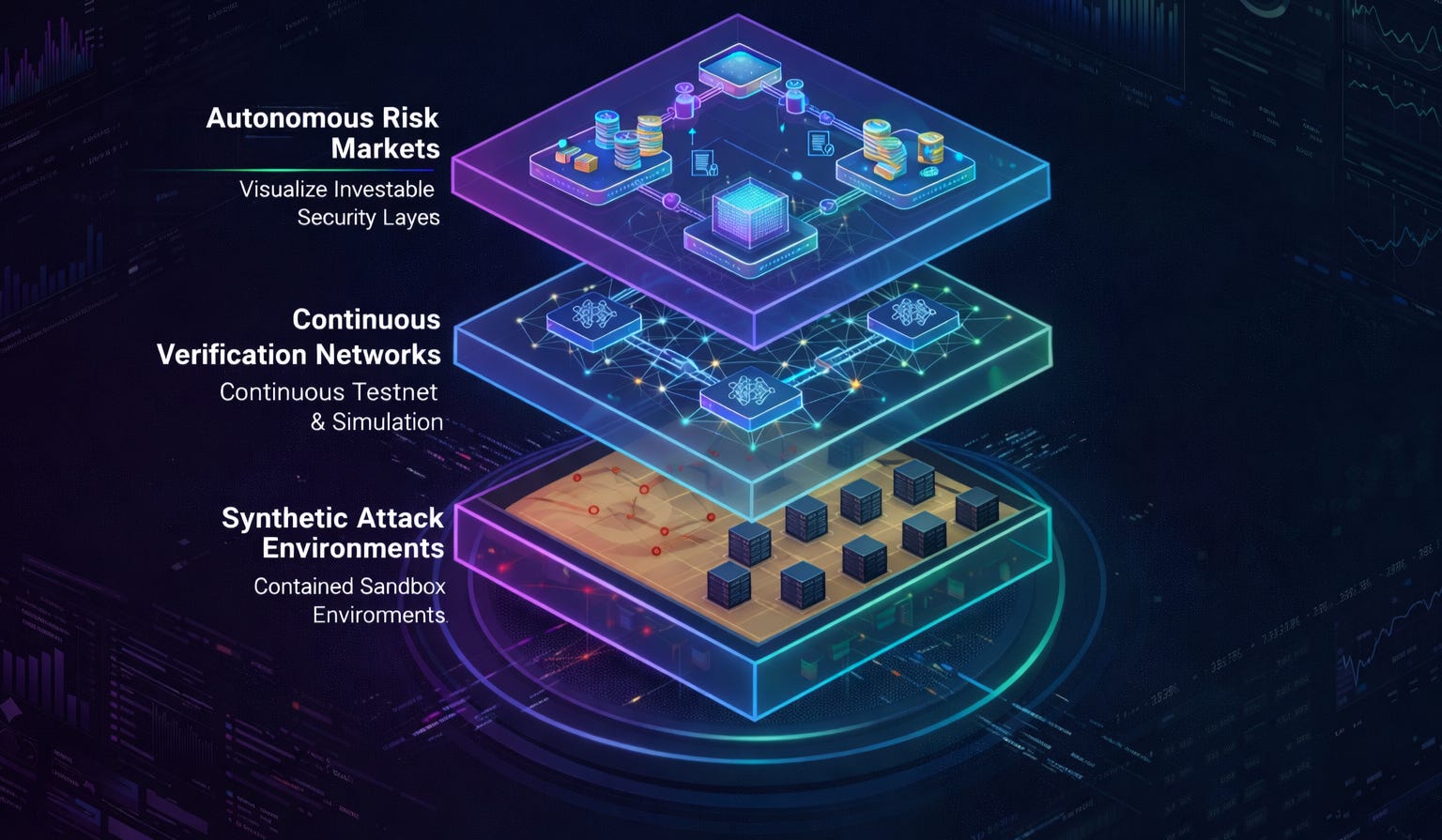
Figure 4: The New Security Stack. The three primary layers of value creation in machine economy security. Synthetic environments simulate adversarial behavior, verification networks continuously stress-test system integrity, and autonomous risk markets allocate capital in response to verified events.
Key Insight: Security evolves from a cost center into a programmable financial infrastructure.
1. Continuous Verification Networks 🔄
Static audits disappear.
Systems continuously simulate adversarial conditions in real time.
For example; Think of a “live penetration test” running 24/7, where AI agents constantly attempt exploits before attackers can.
2. Autonomous Risk Markets 📊
Insurance becomes programmable.
Capital pools respond instantly to verified loss events.
Instead of filing an insurance claim, a smart contract automatically releases funds the moment cryptographic proof of loss is detected.
3. Synthetic Attack Environments 🧪
Decoy systems attract adversarial behavior.
Threats are studied before reaching real infrastructure.
Like cybersecurity honeypots - but enhanced with AI to simulate entire economies, allowing attackers to reveal strategies in controlled environments.
These systems do not just defend the economy.
They make it possible.
Closing Thought
In the human economy, security is something you purchase.
In the machine economy, security is something you inhabit.
A system that cannot defend itself at the speed it operates will not degrade.
It will be dismantled.
Not by force
but by precision.
But an immune system raises a deeper question.
Before a system can defend itself, it must know:
what is self,
and what is not.
In many ways, this is like the immune system’s core function which is not attack, but it is identity. Without distinguishing self from non-self, defense becomes destruction.
And in a world of autonomous agents, that boundary does not yet exist.
Which leads to the next problem:
Machine Identity.
Dr. Saanfor Hubert Suh